What Did Scots Wear Before Kilts?

When we think of traditional Scottish clothing, the kilt immediately comes to mind. Its distinctive pleats, tartan patterns, and cultural significance have made it an iconic garment worn with pride at weddings, festivals, and other important events. However, before the kilt became the symbol of Scottish identity that we know today, Scots wore a variety of different garments, influenced by climate, culture, and available materials. The story of Scottish clothing is deeply intertwined with the region’s history and the evolution of its people.
In this blog, we’ll take a closer look at what Scots wore before the kilt became the cornerstone of their wardrobe. From the early days of Celtic tribes to the medieval period, Scottish fashion evolved significantly, and each stage of this evolution tells us a bit more about the people who lived in the rugged terrain of Scotland. Let’s explore the clothes Scots wore before the kilt became the iconic garment we know and love today.
1. The Celtic Tribes and Their Clothing
Before the emergence of the kilt, the earliest inhabitants of Scotland were Celtic tribes. These tribes were part of the larger Celtic peoples who spread across Europe in ancient times, and their clothing was shaped by their need to survive in a harsh, cold climate. The Celts wore simple, functional garments made primarily from wool, which was abundant in Scotland, and they relied on these garments for warmth and practicality.
Woolen Tunics and Cloaks
In the early days of Scottish history, Celtic men wore basic woolen tunics, often knee-length, paired with cloaks. The tunics were woven from wool, and the design was quite simple, with no intricate patterns or decorations. These tunics were worn for both practical and protective reasons, as the weather in Scotland could be cold and wet for much of the year.
The cloaks, or “brats,” were often fastened with brooches or pins made of metal or bone, and they provided additional warmth. The brats were large, rectangular pieces of cloth that could be draped over the body, much like a modern-day blanket. They were versatile garments, worn by both men and women, and were designed for warmth and functionality.
Animal Skins and Furs
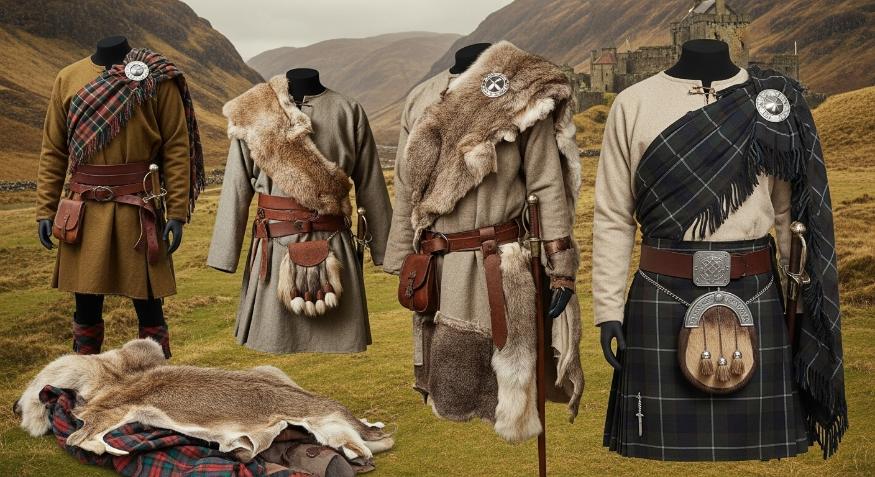
For those living in the more remote parts of Scotland, clothing was often supplemented with animal skins and furs. It was especially true during the colder months when warmth was essential for survival. The Celts used the pelts of animals like deer, bears, and wolves to create cloaks, boots, and other protective garments. These materials were not only functional but also served as a way of showing wealth and status within the community.
Animal skins were also used to craft footwear, with basic leather shoes or boots being common in the Celtic tribes. These shoes were sturdy and designed to withstand the rough terrain of the Scottish Highlands, where the Celts spent much of their time.
2. The ‘Leine’ (The Gaelic Tunic)
By the time Scotland had entered the medieval period, Celtic culture had evolved, and the Gaelic people—those who spoke the Gaelic language and lived in Scotland and Ireland—were beginning to develop a distinct identity. During this time, one of the key garments worn by the Scots was the leine (pronounced “lay-nuh”).
What Was the Leine?
The leine was a loose-fitting tunic made from linen or wool that reached the knee or mid-calf. Both men and women often wore it, and it was the staple garment of the Gaelic Scots. The leine was a functional piece of clothing that was simple yet versatile. It could be worn with a belt around the waist or left loose, depending on the occasion.
The linen was often made from undyed wool or linen. However, wealthier individuals might have dyed their linen in rich colors. The wealthy also had leines made from finer, softer fabrics like silk, while poorer Scots wore simpler, coarser materials.
Styling the Leine
The leine could be decorated with embroidery or other adornments, depending on a person’s social standing. For instance, nobles might wear leines with elaborate embroidery or jewelry, while common folk kept their clothing simple. The leine was worn with a belt that was fastened around the waist to keep it secure. This belt could also serve as a practical accessory, holding tools, pouches, and other necessary items.
For the Scots in the medieval period, the leine was the equivalent of everyday wear. It was worn for both formal and informal occasions, making it an essential part of a person’s wardrobe.
3. Plaid and Tartan: The Early Beginnings
As we move further into the medieval period, we see the rise of plaid and tartan patterns in Scottish clothing. However, the plaid and tartan that we associate with modern kilts did not exist in their current form. Instead, early plaid was a large rectangular piece of cloth, often woven from wool, that could be wrapped around the body for warmth and protection.
The Early Plaid (The Great Kilt)
The precursor to the modern kilt was known as the Feileadh Mòr (pronounced “Fay-lah Mor”), or “Great Kilt.” The Great Kilt was essentially a large piece of woolen cloth, usually plaid, that was wrapped around the body. Men in Scotland wore it, and it was typically fastened at the waist with a belt. The fabric was often hand-woven, and the tartan patterns varied depending on the region or clan.
The Great Kilt was worn much like a cloak, and the extra length allowed the wearer to drape it over his shoulder or use it as a blanket when necessary. This garment was incredibly versatile, providing warmth in the cold Scottish climate and offering protection from the elements. It was also large enough to be used as a sleeping bag or shelter when needed, making it a practical piece of clothing for the rugged environment of the Highlands.
Tartan and Clan Identity
The development of tartan patterns in Scottish clothing is closely linked to the rise of Scottish clans and the desire to establish clan identity. Each clan or family would have its own distinct tartan pattern, allowing members of the clan to recognize one another. These tartan patterns were passed down through generations and became symbolic of a person’s heritage and family lineage.
At first, tartan was not as finely woven or as elaborate as it is today. It was more about practicality than fashion, with simpler designs being the norm. Over time, however, tartan began to evolve into a more standardized pattern, with specific colors and designs representing different clans and regions in Scotland.
4. The Transition to the Modern Kilt
As time went on, the Great Kilt evolved into the more structured modern kilt that we know today. This transformation occurred over several centuries, and the contemporary kilt became more practical, easier to wear, and more tailored to the individual. By the 18th century, the kilt had become a distinctly Scottish garment, worn with pride by men at ceremonies, events, and social gatherings.
The Jacobite Rebellions and the Kilt’s Iconic Status
The Jacobite Rebellions of the 1700s played a significant role in the kilt’s rise to prominence. After the British defeat of the Jacobites, who were fighting to restore the Stuart monarchy, the British government attempted to suppress Scottish culture. The 1746 Act of Proscription banned the wearing of tartan and kilts in an attempt to undermine Scottish identity and prevent rebellion.
However, despite the prohibition, the kilt continued to be worn in secret by Scots as a symbol of resistance. It wasn’t until the 19th century, after the ban was lifted, that the kilt became widely accepted as a symbol of Scottish pride. The romanticization of Scotland’s Highland heritage during the Victorian era further cemented the kilt’s iconic status as a national symbol of Scotland.
5. Why the Kilt Became the Icon of Scottish Identity
The kilt’s journey from the early days of Celtic tunics and animal skins to the modern garment we know today is a story of cultural evolution. The kilt became a symbol not only of national pride but also of resilience and heritage. As Scotland began to develop its own unique identity, the kilt was embraced as a powerful symbol of that identity.
While earlier garments like the leine and the Great Kilt were functional and practical, the modern kilt represents a deeper cultural connection to Scotland’s history. Today, the kilt is worn for various occasions, from weddings to Highland Games, and it serves as a powerful reminder of Scotland’s rich cultural heritage.
Conclusion: The Evolution of Scottish Clothing
The history of Scottish clothing is a fascinating journey that reflects the culture, environment, and history of the people who wore these garments. From the early woolen tunics of the Celtic tribes to the more sophisticated tartan of the Great Kilt, each phase of Scottish fashion tells a unique story of adaptation and survival.
Before the kilt became the emblem of Scottish pride, Scots wore a variety of garments that were influenced by their surroundings, their needs, and their social structures. Understanding what Scots wore before the kilt helps us better appreciate the evolution of Scottish fashion and the importance of the kilt as a symbol of identity and culture.
Whether you’re interested in history, fashion, or Scottish culture, the evolution of Scottish clothing is a fascinating topic that offers valuable insights into the lives of the people who once lived in the rugged and beautiful land of Scotland.
FAQ’s:
Before the kilt, Scots wore basic woolen tunics, cloaks, and animal skins for warmth. The leine (a loose-fitting tunic) was common, along with plaid or tartan fabric wrapped around the body.
The leine was a loose tunic worn by Scots, made from linen or wool. It was an everyday garment worn by both men and women and was often secured with a belt around the waist.
The Great Kilt, or Feileadh Mòr, was a large piece of plaid fabric wrapped around the body, often used as both a cloak and a skirt. It was the precursor to the modern kilt and provided warmth and flexibility in the harsh Scottish climate.
Tartan patterns were used to signify clan identity. Each clan had its own distinctive tartan, and over time, this plaid became a symbol of Scottish pride, especially during the 18th century.
The kilt evolved into its modern form by the 18th century, particularly after the Jacobite Rebellions. The contemporary kilt became more structured, and the ban on tartan was lifted, cementing the kilt as a symbol of Scottish identity.